RAF Hornchurch, situated in the London Borough of Havering, served as a critical defensive installation throughout both the First and Second World Wars. The airfield's strategic position, fourteen miles east-northeast of Charing Cross, made it ideally placed to intercept enemy aircraft approaching London from the east.
Origins as Sutton's Farm
The airfield began its military life on 3 October 1915 as Sutton's Farm, a modest 90-acre site established to defend London against German Zeppelin raids. The War Office had established the London Air Defence Area (LADA) that same year, recognising the growing threat posed by enemy airships. The station initially operated with just two BE2c aircraft.
The airfield's first notable engagement occurred on 13 October 1915, when Lieutenant John Slessor, who would later rise to become Marshal of the RAF, attempted an interception that was aborted due to cloud cover. The breakthrough came on 2 September 1916, when Lieutenant William Leefe Robinson achieved the first British aerial victory over London, shooting down the German airship Schütte-Lanz SL11 using new incendiary ammunition. Robinson was awarded the Victoria Cross for this action, becoming the first recipient of the decoration for airship interception.
Other pilots stationed at Sutton's Farm who achieved Zeppelin kills included Lieutenant Frederick Sowrey and Lieutenant Wulstan Tempest, both of whom were awarded the Distinguished Service Order. The airfield hosted No. 39 (Home Defence) Squadron from April 1916 to September 1917, followed by No. 78 Squadron until the armistice. No. 189 Night Fighter Training Squadron also operated from the site between April 1918 and March 1919.
The station closed on 31 December 1919, and the land returned to agricultural use.
Rebirth as RAF Hornchurch
The site remained dormant for several years until 1923, when the Air Ministry began a four-year programme to re-purchase and expand the land. The airfield reopened in April 1928 as RAF Sutton's Farm, but was renamed RAF Hornchurch just two months later.
Squadron Leader Keith Park assumed command as the station's first commanding officer. Park would later achieve fame as Air Officer Commanding No. 11 Group during the Battle of Britain, earning the nickname "The Defender of London."
The first unit to operate from the renamed station was No. 111 Squadron, equipped with Armstrong Whitworth Siskin IIIA aircraft. The airfield's location was deliberately chosen for its defensive advantages; it sat directly in the path of potential enemy approaches along the Thames corridor.
The Second World War
When war broke out in September 1939, RAF Hornchurch formed part of RAF Fighter Command's No. 11 Group, which bore responsibility for the defence of London and south-east England. The station would become one of the most heavily engaged airfields during the Battle of Britain.
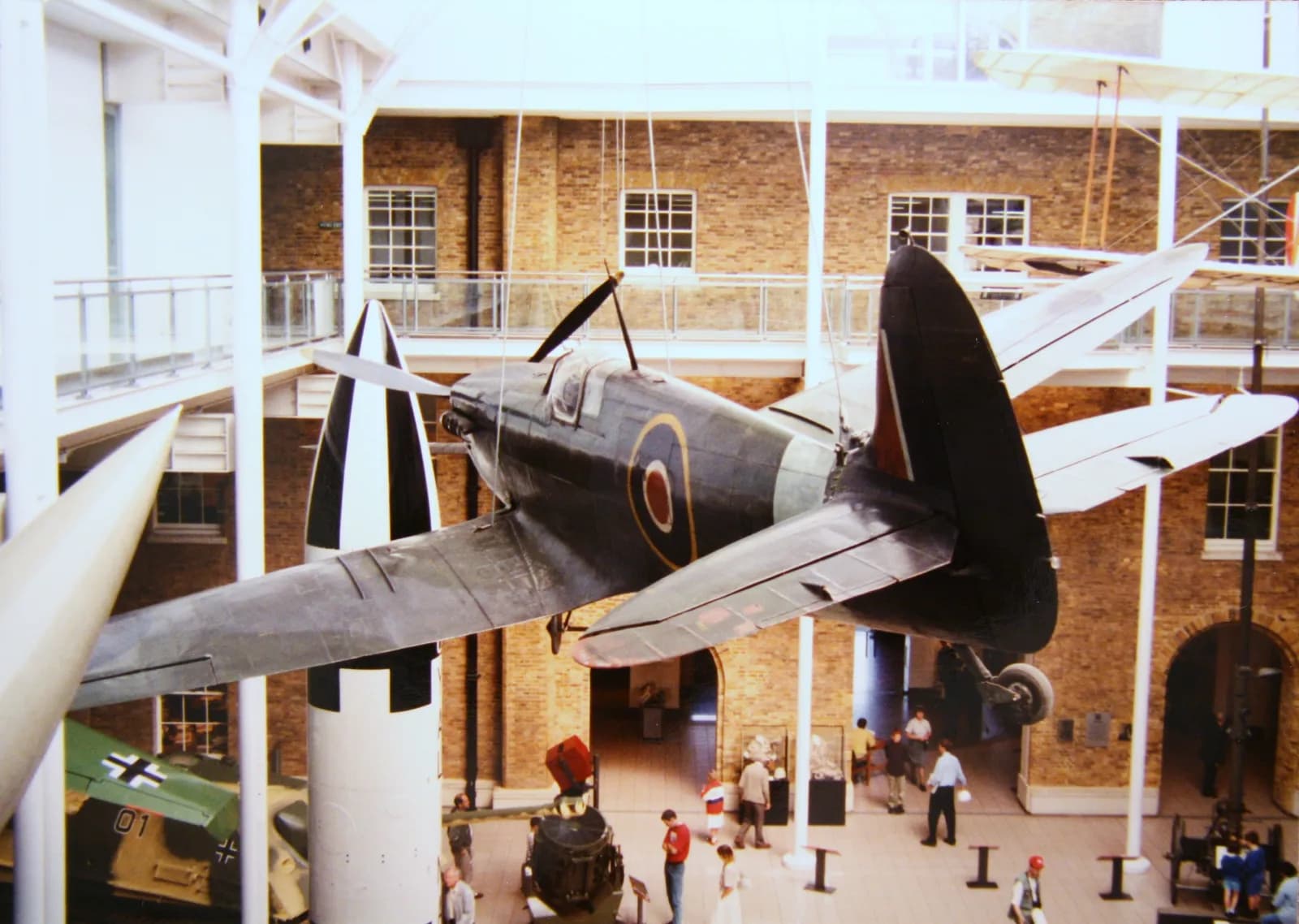
The airfield suffered Luftwaffe raids on twenty occasions during the conflict. Despite this, it continued to host successive waves of Spitfire and Hurricane squadrons. No. 54 Squadron operated Spitfire Mk I aircraft from March 1939 until September 1940. No. 65 Squadron flew similar aircraft from March 1939 to August 1940. The renowned No. 74 Squadron, known as the "Tiger Squadron," was based at Hornchurch from February 1939 to August 1940.
Other squadrons passing through included No. 41 Squadron, which operated from Hornchurch during multiple periods in 1940 and 1941, and No. 222 Squadron, which flew Spitfire Mk I and later Mk IX aircraft between August and November 1940, returning from April to December 1943.
Notable Incidents and Personnel
One of the more unfortunate episodes in the airfield's history occurred on 6 September 1939, just days after war was declared. Spitfires from Hornchurch's No. 74 Squadron shot down two Hurricanes from No. 56 Squadron in an incident that became known as the Battle of Barking Creek. Pilot Officer Montague Hulton-Harrop became the first British pilot killed in the Second World War. The friendly fire incident led to significant improvements in aircraft identification and communication procedures.
On 19 August 1942, three squadrons from Hornchurch participated in the Dieppe Raid, providing air cover for the amphibious assault on the French coast.
By late 1944, the station's role had shifted. Barrage balloons deployed nearby to counter V-1 flying bombs made flying operations unsafe, and the airfield's active combat role effectively ended.
The airfield attracted remarkable personnel. Group Captain Adolph "Sailor" Malan, who commanded No. 74 Squadron at Hornchurch, would go on to shoot down twenty-seven Luftwaffe aircraft. Richard Hillary, author of the celebrated memoir "The Last Enemy," was based at Hornchurch from 27 August 1940. During his first week at the station, he claimed five kills before being shot down himself on 3 September.
Another notable figure was Wing Commander Don Finlay, an Olympic hurdler who had won bronze in 1932 and silver in 1936. Finlay commanded No. 41 Squadron from Hornchurch during 1940 and 1941, earning the Distinguished Flying Cross.
Post-War Years and Closure
Following the war, RAF Hornchurch entered a period of reduced activity. It served as a reserve station until 1947, when No. 17 Reserve Flying School commenced operations, continuing until 1953. An Aircrew Selection Centre moved to Hornchurch in 1952, and balloon operations continued for parachute training. In May 1961, CSM Albert E. Small was awarded the George Medal for gallantry after helping to deflate a runaway balloon at eight hundred feet.
The station finally closed in July 1962, bringing nearly half a century of military aviation at the site to an end.
Legacy in Havering
The closure of RAF Hornchurch marked not the end of its story, but rather a transformation. During the 1960s, the hangars and technical areas were demolished to make way for a housing estate. The 1970s saw gravel extraction and landfill operations across the site. Work began on creating Hornchurch Country Park in 1980, and the resulting 104.5-hectare green space opened to the public.
The park now holds Grade I status as a Site of Borough Importance for Nature Conservation and forms part of the Ingrebourne Valley Local Nature Reserve. Visitors walking through the park today encounter tangible reminders of its military past; pillboxes, command bunkers, and gun positions remain scattered throughout. The park contains the largest concentration of surviving Tett Turrets in England, these partially buried pillboxes offering a distinctive reminder of wartime defensive architecture.
The housing estate built upon the former administrative and technical areas preserves the airfield's memory through its street names. Bouchier Walk, Kirton Close, Tempest Way, Robinson Close, Tuck Road, Bader Way, and Malan Square all honour notable figures associated with the station.
Several original buildings survive within the RAF Hornchurch Conservation Area. Astra House, formerly the Officers' Mess, now serves as a doctors' surgery. The Astra Court buildings were formerly Officers' Quarters, and the former Warrant Officers' Quarters on Wood Lane also remain.
Preserving the Memory
Local efforts to preserve RAF Hornchurch's heritage have intensified in recent years. The Hornchurch Aerodrome Historical Trust opened the RAF Hornchurch Heritage Centre in Suttons House, Suttons Lane, in June 2021. The centre's official opening followed on 23 September 2021, providing residents and visitors with a dedicated space to explore the airfield's history.
The Purfleet Heritage and Military Centre houses additional artefacts and memorabilia relating to the station. The Good Intent pub on Southend Road, which was popular with aircrews during the war years, retains photographs of the station.
Two local schools maintain connections to the airfield's history. Sanders Draper School was renamed in 1973 after Flying Officer Raimund "Smudge" Sanders Draper, an American pilot serving with the RAF who remained at the controls of his failing aircraft to avoid hitting the school below, sacrificing his own life. R.J. Mitchell School, named for the designer of the Spitfire, hosts a monument where wreaths are laid each Remembrance Day.
On 23 March 2022, the COVID-19 Memorial Woodland opened in the southern portion of Hornchurch Country Park. Local volunteers planted more than four thousand trees, creating a living memorial that now grows upon ground once occupied by one of Britain's most significant wartime airfields.